
tax
2027 Federal Income Tax Brackets and Standard Deduction
See the 2027 IRS tax brackets for each filing status, compare the 2026 and 2027 standard deductions, and work through a federal tax example.
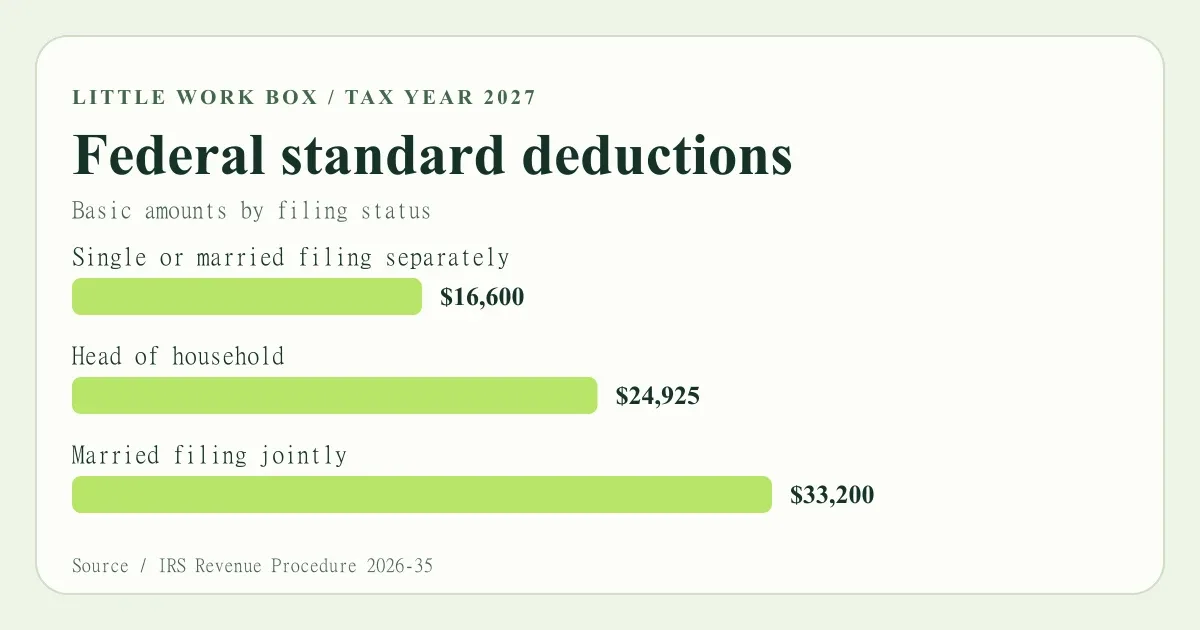
For tax year 2027, the basic federal standard deduction is $16,600 for single and separate filers, $24,925 for heads of household, and $33,200 for joint filers and qualifying surviving spouses. The IRS also raised the income thresholds for each bracket. The seven ordinary-income rates still run from 10% to 37%. The new thresholds generally apply to income earned in 2027 and reported on a return filed in 2028.
Use the federal income tax calculator to compare 2027 with 2026 and see the tax charged in each bracket. The IRS inflation-adjustment announcement summarizes the changes. The full filing-status schedules are in IRS Revenue Procedure 2026-35.
2027 federal income tax brackets by filing status
The dollar amounts are taxable-income thresholds. Each rate applies to income above the displayed threshold up to the next threshold. Joint figures also apply to qualifying surviving spouses.
The first dollars are taxed at 10% for every filing status. The amounts below start the 12%, 22%, 24%, 32%, 35% and 37% brackets, in that order. The calculator presents the same amounts side by side.
- Single — $12,800, $52,025, $109,125, $208,325, $264,550 and $661,375.
- Married filing jointly — $25,600, $104,050, $218,250, $416,650, $529,100 and $793,650.
- Married filing separately — $12,800, $52,025, $109,125, $208,325, $264,550 and $396,825.
- Head of household — $18,250, $69,650, $109,100, $208,300, $264,550 and $661,350.
At exactly $52,025 of taxable income, a single filer has $5,987 of bracket tax. The next dollar adds 22 cents. Entering the higher bracket changes the rate on the additional income.
How much is the 2027 standard deduction?
- Single or married filing separately — $16,600, up $500 from $16,100.
- Head of household — $24,925, up $775 from $24,150.
- Married filing jointly or qualifying surviving spouse — $33,200, up $1,000 from $32,200.
These are the basic amounts. Dependents, people age 65 or older or who are blind, and spouses filing separately when the other spouse itemizes can have different amounts or rules. If you itemize or qualify for additional deductions, calculate taxable income first and enter it directly in the calculator. The IRS 2026 procedure covers the earlier year's figures.
Worked example for a single filer
Assume $100,000 in 2027 adjusted gross income from ordinary income and eligibility for the basic $16,600 deduction. Taxable income is $83,400.
- The first $12,800 at 10% produces $1,280 in tax.
- The next $39,225 at 12% produces $4,707.
- The remaining $31,375 at 22% produces $6,902.50.
The estimate is $12,889.50 before credits. The marginal bracket reached is 22%. Divide the estimate by the $100,000 adjusted gross income to get an effective rate of about 12.89%. Dividing by taxable income instead gives about 15.46%, so check which denominator a calculator uses when comparing estimates.
For the same $100,000 in 2026, the basic deduction gives $83,900 of taxable income. The 2026 schedules give $13,170 before credits. The $280.50 difference reflects both the change in the deduction and the larger bracket thresholds.
Worked example for a married couple filing jointly
A couple with $100,000 in ordinary adjusted gross income and the basic $33,200 deduction has $66,800 in taxable income. They owe $2,560 on the first $25,600 and $4,944 on the next $41,200 at 12%. The estimated federal tax before credits is $7,504, or about 7.50% of adjusted gross income. Their marginal rate is 12%.
Frequently asked questions
Which year should I choose?
Use the tax year of the income. A return filed in early 2027 for income earned in 2026 generally uses the 2026 table. When planning a raise or a change in household income for calendar year 2027, compare scenarios with the 2027 table.
Does this tell me how much my employer will withhold?
The example estimates federal ordinary-income bracket tax before credits. A paycheck also reflects withholding elections and pay frequency, payroll taxes and any state or local deductions. Long-term capital gains and qualified dividends can use separate schedules. For annual state comparisons, see the New York income tax calculator or the California income tax calculator.
Do the brackets apply to my entire salary?
Federal brackets apply in layers to taxable income after deductions. Your marginal rate is the rate on the next dollar of ordinary taxable income, while the effective rate expresses your total estimated tax as a share of income.
Can spouses who file separately both take the standard deduction?
If either spouse itemizes on a separate return, the other generally must itemize too. The $16,600 figure is the basic deduction for a separate filer who qualifies.